The strategic moat surrounding Tesla’s charging infrastructure has transformed into the primary foundation for North American electric vehicle travel. For automotive executives, fleet operators, and infrastructure investors, what began as a proprietary charging network has officially matured into the continental standard.
Behind the straightforward capability of seamless coast-to-coast EV transit sits a massive dense data footprint that is rapidly shifting the economics of long-distance transport.
Market Dominance: The Network by the Numbers
Tesla operates 3,088 public DC fast-charging stations housing 37,428 individual ports across the United States. To put this in perspective for corporate asset managers, this single footprint commands 52% of all DC fast-charging ports in the nation. Pulling up to any public fast charger in America presents a better than coin-flip chance of plugging into a Tesla post. Globally, the network has surpassed 80,000 active stalls. Domestic capacity scaling remains aggressive, with stations and ports increasing by 24% and 29% respectively over a 12-month period. This breakneck expansion has seen the addition of nearly 6,800 new ports, absorbing a disproportionate share of the country’s total public fast-charging growth.
The Reliability Standard and Highway Spacing
The operational reality of long-distance EV transit relies entirely on spacing and high hardware uptime. Across major U.S. interstate corridors, fast-charging hubs are now optimized at a tight density of every 50 to 70 miles. Present-day high-voltage systems can inject up to 200 miles of range into compatible vehicles in roughly 15 minutes, aligning the EV charging stop with traditional consumer rest-break durations.
From an operations and maintenance (O&M) perspective, the infrastructure sets the benchmark for reliability:
● High Success Rate: Independent data from J.D. Power reveals that Tesla Superchargers hold the highest reliability scores in the industry.
● Low Failure Margin: The hardware posts a remarkably low 4% failure rate during active user charging visits.
● Verified Uptime: The network’s automated internal logging tracks a consistent uptime exceeding 99.9%, a critical metric for enterprise fleet planning.
Hardware Evolution: Shifting to 500 kW V4 Cabinets
The physical footprint is evolving alongside its capacity. Production has officially transitioned away from V3 Supercharger cabinets to accelerate the rollout of the V4 hardware line. The newly deployed V4 architecture elevates maximum power output up to 500 kW per stall for high-voltage vehicle platforms. The inaugural operational 500 kW V4 station on the East Coast opened in Kissimmee, Florida, establishing the blueprint for high-volume travel corridors. As this higher-power hardware scales, charging times will continue to fall for next-generation 800V and 1,000V battery architectures.
Universal Integration and the Final SAE J3400 Domino
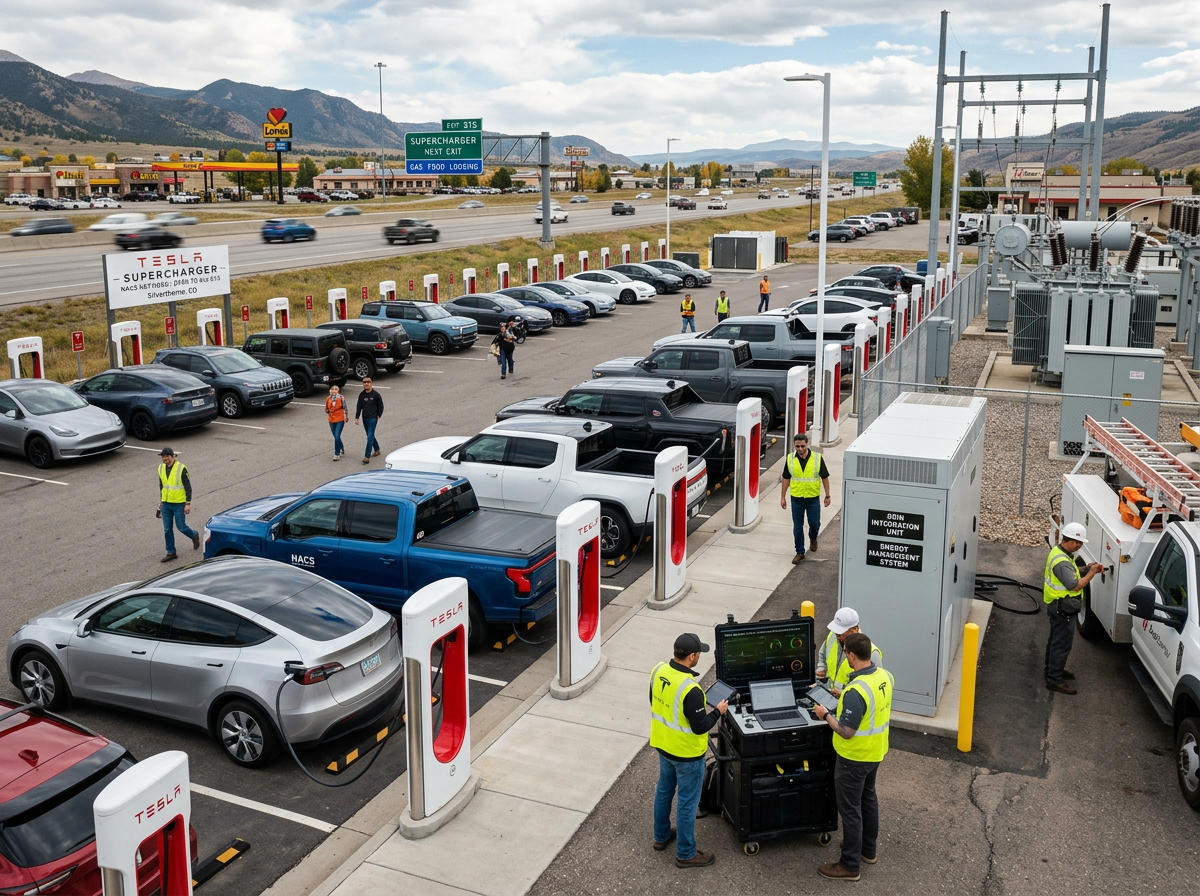
The cross-industry transition to the North American Charging Standard (NACS)—formally codified as SAE J3400—has reached full execution. Over 27,500 Supercharger stalls across the region are now fully accessible to non-Tesla electric vehicles.
The final major automotive conglomerate joined the network when Stellantis officially unlocked access for its sub-brands, including Jeep, Ram, and Dodge. This follows successful integrations from Ford, GM, and Rivian.
The expansion strategy is equally thorough across Canada, where the network features more than 3,000 high-power ports. Over 90% of Canada’s locations operate with universal access, and all future site layouts mandate cross-brand compatibility.
With virtually every global automaker actively delivering factory-built native ports or certified adapters, the network has decoupled from its single-brand origins. It stands as the unified, open-access backbone of North American industrial transport.