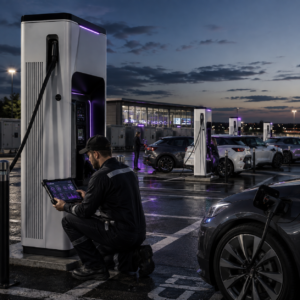

Five developments that stood out across public charging, fleet electrification, and infrastructure deployment.
July was defined less by breakthrough charging technologies and more by how charging infrastructure is being deployed at scale. Public agencies expanded procurement, municipalities increased investment in fleet charging, and local authorities continued to build larger public charging networks.
Together, these developments point to an industry focused on execution rather than experimentation.
1. Public Procurement Is Becoming a Growth Channel
One of the month’s most significant developments came from the U.S. public sector.
Verdek added Tesla’s V4 Supercharger technology to its U.S. General Services Administration (GSA) Multiple Award Schedule, allowing eligible federal agencies to procure
high-power charging infrastructure through an established government purchasing framework.
For charging providers, this reduces procurement complexity while opening larger institutional deployment opportunities.
2. Fleet Charging Is Moving Beyond Pilot Projects
The City of Dallas placed its fourth order for Beam Global’s EV ARC™ charging systems since 2025.
Rather than representing another isolated installation, the repeat procurement indicates continued investment in infrastructure that has already demonstrated operational performance.
Repeat orders are becoming an increasingly useful indicator of charging market maturity, particularly in the municipal fleet sector.
3. Public Charging Networks Continue to Expand
In the UK, Hertfordshire County Council partnered with Zest to deploy more than 1,000 public EV chargepoints across multiple districts.
Projects of this scale demonstrate that local authorities are increasingly treating charging infrastructure as part of long-term transportation planning rather than individual infrastructure projects.
4. Deployment Speed Is Becoming a Competitive Advantage
Several July announcements highlighted infrastructure designed to reduce installation timelines.
Off-grid charging systems, modular deployments, and procurement frameworks that minimize construction requirements are gaining traction as fleet operators seek faster implementation while avoiding extensive grid upgrades and civil works.
Deployment strategy is increasingly becoming as important as charging technology itself.
5. Infrastructure Planning Is Becoming More Strategic
The International Energy Agency’s Global EV Outlook 2026 reinforces that charging infrastructure must continue expanding alongside EV adoption, particularly for high-power public charging and commercial fleet operations.
As charging networks become larger and more interconnected, investment decisions increasingly involve utilities, municipalities, charging operators, fleet owners, and real estate developers rather than a single stakeholder.
Executive Perspective
The most important takeaway from July is not that more chargers were announced. It is that charging infrastructure is becoming institutional.
Federal procurement frameworks are simplifying deployments. Municipalities are placing repeat orders rather than testing new technologies. Local authorities are investing in large-scale public charging programmes. At the same time, deployment models are evolving to reduce installation time and improve operational flexibility.
Collectively, these developments suggest that the next phase of market growth will be driven less by technology announcements and more by the ability to deploy charging infrastructure efficiently, reliably, and at scale.