The U.S. National Electric Vehicle Infrastructure program is beginning to look less like a federal funding initiative and more like a developing charging network.
A significant example came this month in Wisconsin, where the state announced $25 million in NEVI funding for 42 new fast-charging locations across 42 communities. The awards mark an important step in the state’s charging strategy: Wisconsin has completed the initial buildout needed to place charging along its key interstate and highway corridors, allowing the next round of investment to move into additional U.S. and state highway routes.
That change matters.
The next phase of America’s charging market will not simply be about filling gaps on major interstate routes. It will increasingly be about where charging infrastructure can deliver the most value, how sites are designed for future demand and whether operators can build sustainable businesses around them.
NEVI Is Moving Beyond the First Layer of the Network
The NEVI program was designed to establish a national fast-charging network along designated Alternative Fuel Corridors.
Wisconsin’s progress illustrates what happens when a state reaches that initial objective.
The latest awards target U.S. and state highway corridors that were not included in the state’s earlier rounds of funding. Proposed locations include communities such as Milwaukee, Madison, Racine, Eau Claire and Green Bay, as well as smaller markets across the state.
The significance is not simply the number of new stations.
It is the change in deployment strategy.
Once the primary interstate network is sufficiently covered, the value of another charging site increasingly depends on local traffic, surrounding amenities, EV adoption, grid availability and the ability to expand as demand grows.
That makes the site-selection decision considerably more commercial.
The Next Charging Locations Will Have to Work Harder
Wisconsin’s latest program is particularly revealing because the state is looking beyond simply putting chargers on a map.
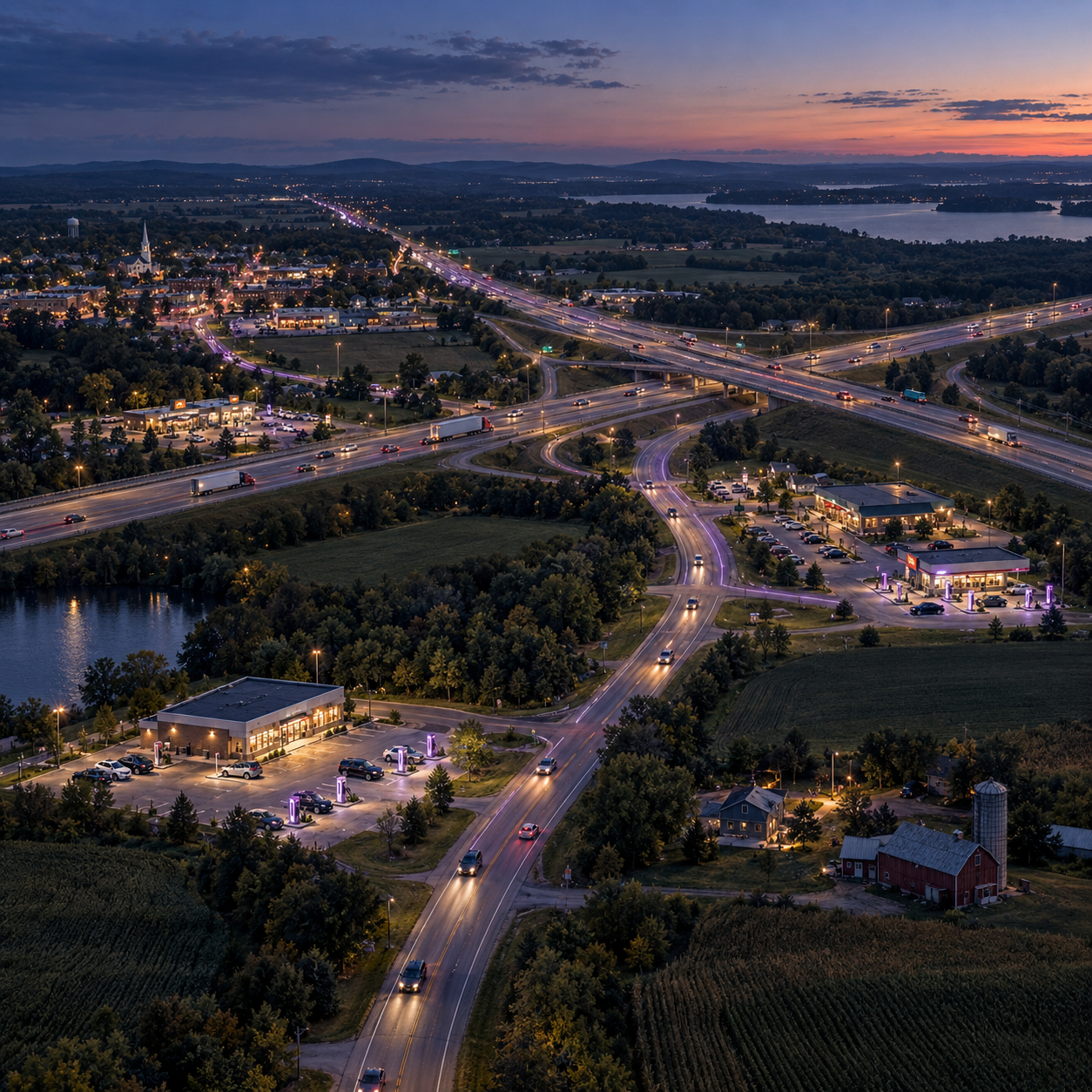
The selected projects are being developed at existing businesses including convenience stores, restaurants, hotels and grocery locations.
That creates a different model for charging infrastructure.
A charging stop becomes part of a broader customer journey rather than an isolated piece of electrical equipment.
Drivers can charge while shopping, eating or staying overnight. Businesses gain an opportunity to attract EV customers. Operators gain access to locations that already have established traffic and amenities.
For charging networks, this can be important as the industry moves toward a more mature operating model.
The question is no longer simply:
Where can we install a charger?
It becomes:
Where can charging become a useful, repeatable and scalable part of the network?
Corridor Coverage Is Giving Way to Network Strategy
Wisconsin’s experience also points toward a broader transition for the U.S. market.
Early public charging investment naturally focused on major travel corridors. Drivers needed confidence that they could travel between cities without running out of charge.
That problem is gradually becoming more nuanced.
As corridor coverage improves, network operators have to consider what happens between those major routes.
Rural communities remain important. Secondary highways can connect significant population centers and tourism destinations. Smaller towns can become useful charging stops when positioned around the right combination of traffic, amenities and grid access.
The latest Wisconsin awards include locations along routes such as US-10, US-12, US-18, US-45, US-61 and US-63, alongside multiple state highways.
This is the next layer of network development: not simply more chargers, but more connected charging coverage.
The Economics Become Harder as the Network Expands
Public funding can help overcome the upfront cost of charging infrastructure, but it does not remove the operating challenges.
Every new site introduces questions around electricity costs, demand charges, maintenance, uptime, land use and utilization.
Those questions become particularly important when charging expands into lower-density markets.
A site may be strategically valuable because it closes a geographic gap without immediately generating the utilization of a high-volume urban charging location.
That makes public funding an important catalyst, but not a substitute for commercial discipline.
Operators still need to understand:
● Expected charging demand
● Grid and interconnection requirements
● Electricity and demand costs
● Site operating costs
● Future capacity requirements
● Customer dwell time
● Nearby competing networks
● Opportunities for expansion
The charging infrastructure that succeeds at scale will need to balance network value with site-level economics.
Designing for the Next Wave of EV Demand
Another important detail in Wisconsin’s program is that the new sites are being selected with future development in mind.
That is increasingly important as charging technology and vehicle demand evolve.
WisDOT says the state has achieved full buildout of its initial federal corridor requirements, giving it greater flexibility to direct investment toward secondary highways and other locations.
The infrastructure installed today therefore needs to be capable of serving tomorrow’s vehicles.
That means considering more than the minimum number of charging ports.
Power levels, electrical infrastructure, site layout, vehicle mix, larger vehicles and the ability to add capacity later can all affect whether a charging location remains useful as demand increases.
The latest Wisconsin awards show that this is already influencing project selection, with the state evaluating factors including location, future development potential, space for larger EVs and extended business hours.
NEVI’s Next Test Is Performance
There are now more than 200 open NEVI-funded fast-charging sites across the U.S., spanning more than 20 states. Current tracking puts the network at roughly 215 sites and 1,500 DC fast-charging ports as of September 13.
That changes the industry’s challenge.
The early question was whether public funding could produce a national charging backbone.
The next question is whether that backbone can perform.
Can stations maintain high uptime?
Can operators achieve enough utilization to justify continued investment?
Can utilities support higher-powered sites?
Can networks expand capacity without repeatedly rebuilding the same locations?
And can charging infrastructure move from individual funded projects into commercially viable, interconnected networks?
Wisconsin’s latest awards offer a useful indication of where the market is heading.
The next stage of U.S. EV charging will not be defined only by how many chargers are built. It will be defined by how intelligently they are located, how reliably they operate and how effectively they can scale with demand.
NEVI helped establish the foundation.
Now the industry has to build the network around it.