EV charging infrastructure is increasingly being built around an existing asset: the places people already visit.
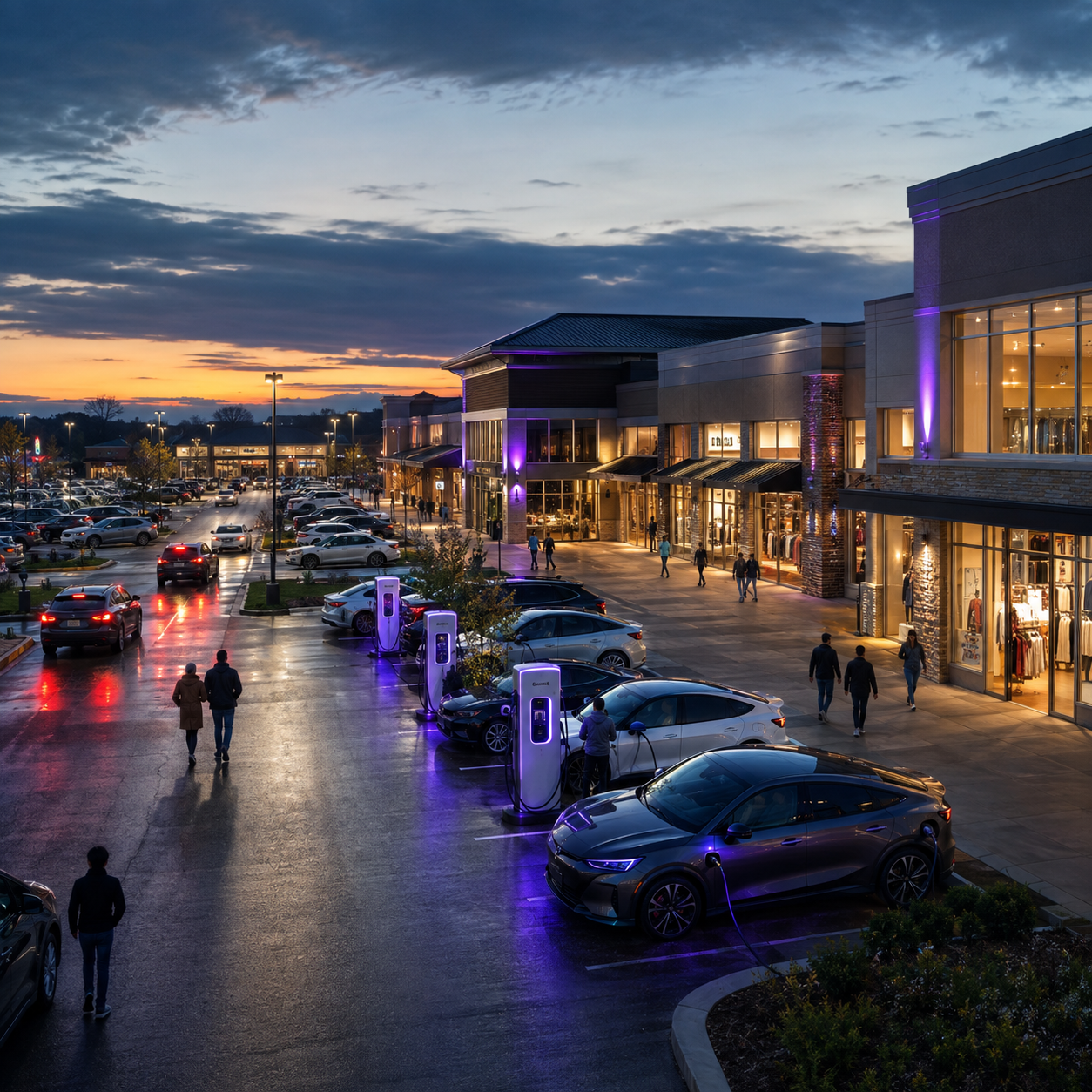
EVgo and Brixmor Property Group are expanding their partnership with plans for more than 500 additional DC fast-charging stalls across shopping centres in Florida, Illinois, Minnesota, New Jersey, Pennsylvania and Texas. The expansion is expected to bring EVgo charging to at least 90 Brixmor properties.
The sites are expected to accommodate up to 12 high-power chargers each, with the first location under the expanded agreement planned for Barn Plaza near Philadelphia.
The significance is less about the number of chargers than the location strategy behind them.
Charging Where the Customer Already Goes
A fast charger does not exist in isolation from its surroundings.
A driver who needs to spend 20 or 30 minutes charging may also be buying groceries, eating, running errands or visiting nearby businesses. That makes retail centres particularly relevant to charging operators looking for locations that can combine charging demand with established traffic patterns.
EVgo has already pursued this model through partnerships with grocery retailers, shopping-centre owners, restaurants and other businesses. Its current network spans retail and commercial locations across the U.S.
For property owners, the proposition is equally different from simply adding another amenity.
Charging infrastructure can become part of how a property is used, extending the role of the site beyond its conventional retail function.
The Location Economics Matter
The expansion also highlights one of the central questions facing the U.S. charging market: where should high-power charging capacity be built?
A site needs more than sufficient electrical capacity.
Operators have to consider traffic, parking availability, grid connection requirements, competing charging infrastructure and the likelihood that drivers will actually use the site.
Retail locations offer one advantage: they already have an established reason for people to be there.
That does not guarantee charging utilization, but it can provide a stronger foundation for demand than developing charging capacity without an existing destination around it.
Fast Charging Is Becoming Part of Commercial Real Estate
The relationship between charging infrastructure and property owners is therefore becoming more significant.
For shopping-centre operators, EV charging can sit alongside other services that influence how customers use a property. For charging companies, access to established retail locations can reduce some of the challenges involved in finding destinations with sufficient traffic and customer relevance.
This creates a shared infrastructure model.
The property provides the location and surrounding activity. The charging operator provides the equipment, network and operational capability.
The commercial outcome depends on how effectively those pieces work together.
Scale Brings an Operational Question
Expanding the physical network is only one part of the equation.
EVgo’s existing network illustrates the operational complexity involved in running a large fast-charging footprint. The company operates thousands of DC fast-charging stalls across the U.S., with its network extending across 47 states.
At that scale, reliability becomes inseparable from the value of the physical infrastructure.
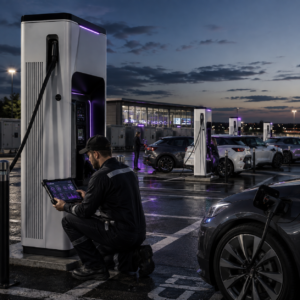
A charger that is unavailable does not provide useful capacity, regardless of where it is located. Operators therefore have to manage equipment performance, diagnostics, maintenance and field response alongside site expansion.
EVgo has previously invested in data-driven monitoring and maintenance systems to identify equipment issues and accelerate repair response, illustrating how network operations increasingly sit alongside physical deployment as a core part of charging infrastructure management.
The Retail Charging Model Has a Larger Implication
The EVgo-Brixmor expansion points to a broader development in the U.S. charging market.
Charging infrastructure does not necessarily need to compete with existing commercial activity. It can be integrated into it.
That opens up a wider pool of potential sites, from grocery-anchored shopping centres to restaurants, convenience stores, hotels and other destinations where drivers already spend time.
The strategic question for infrastructure investors and operators is therefore becoming more specific:
Which locations can support both the physical requirements of fast charging and the customer demand required to make those assets productive?
As the U.S. network expands, that question could become as important as the number of chargers being installed.
The next stage of charging infrastructure growth may be determined less by finding empty land for chargers and more by finding the right places to put them.