
America’s fast charging network has quietly reached a new scale.
As of September 1, 2026, the United States had 76,236 public DC fast charging ports across roughly 15,798 locations, according to Alternative Fuels Data Center figures compiled by EVChargingStations.com in its September network report. That is 23% more than a year earlier. Deployment in 2026 has averaged more than 1,000 new stalls a month.
The headline number is impressive on its own. The detail underneath it is more useful. Sites are getting larger, the field of serious operators is getting wider, and new entrants are scaling faster than the incumbents did at the same stage.
That is what a maturing network looks like.
The Growth Is Coming From Deeper Sites, Not Just More Dots
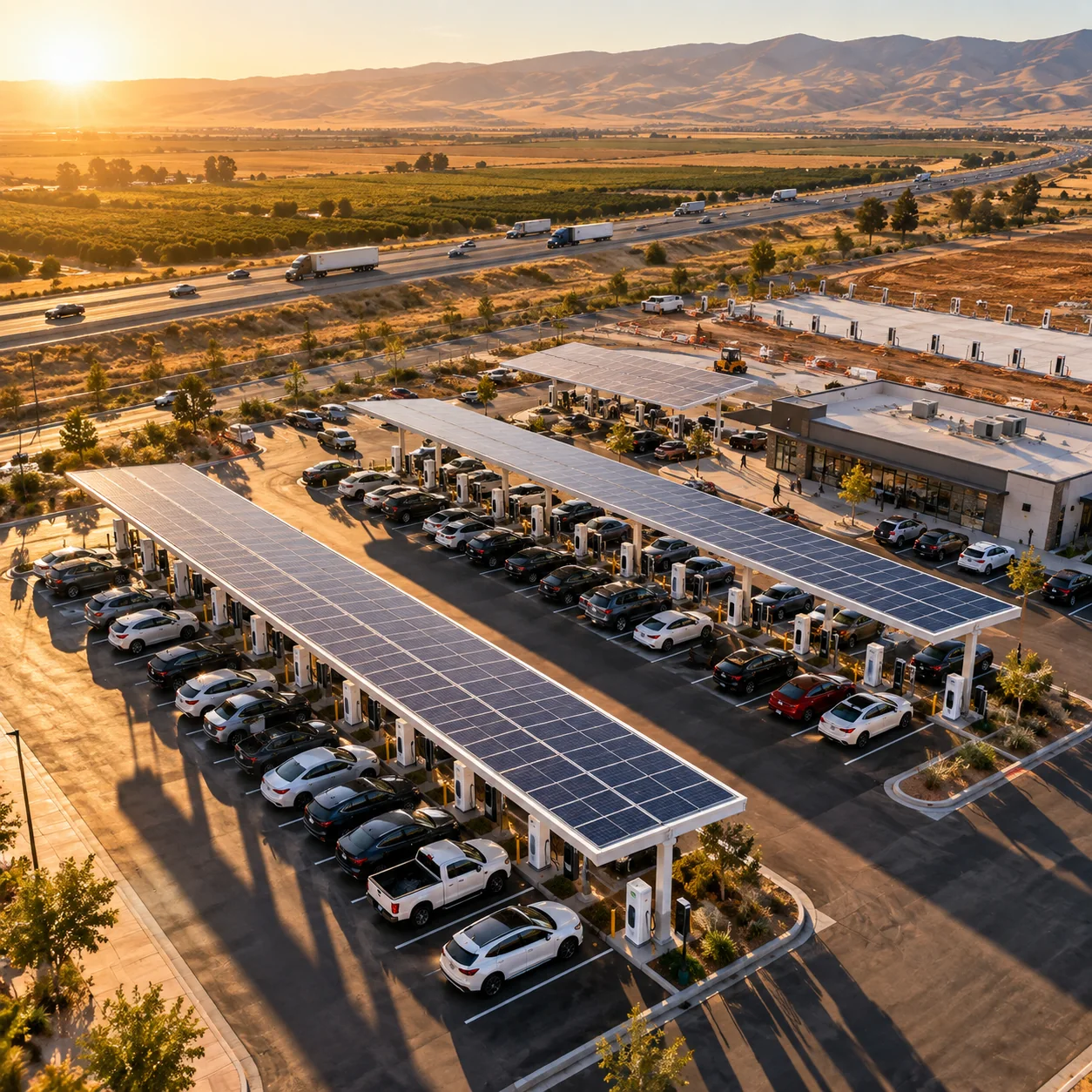
One figure in the report deserves more attention than it will get. The average number of ports per location has risen to 4.83, up from 4.47 a year ago.
That shift matters for drivers and for operators. A two-stall site with one charger down is a failed stop. A ten-stall site with one charger down is a minor inconvenience. Larger sites absorb faults, queue spikes and holiday peaks in a way small sites cannot.
They also change the economics. Grid upgrades, transformers, trenching and permitting are largely fixed costs per site. Spreading them across more stalls lowers the cost per port and gives operators room to add capacity later without starting over.
The data also offers a reasonable read on availability. Of the 76,236 ports, 933, or 1.2%, were listed as temporarily unavailable on September 1. That figure does not capture every failed session, but it is a useful baseline as the industry pushes toward higher uptime targets.
The Field Beyond Tesla Is Getting Crowded in a Good Way
Tesla’s Superchargers still account for 37,995 ports, or 49.8% of the national total. The more interesting story is the other half of the market, which now holds more than 38,000 ports spread across a growing list of credible operators.
Electrify America ranks second with 5,936 ports, followed by EVgo with 5,246 and ChargePoint with 4,937. Red E Charge, Blink, EV Connect, Ionna, Ford Charge and Rivian Adventure Network complete the top 10, which together control roughly 84% of all ports.
Movement within that list is the signal to watch. Ionna added 268 stalls in two months, partly by taking over Circle K sites, and climbed to eighth place with 1,458 ports. Red E Charge also moved up a position.
For investors, this is a healthier structure than a market dominated by one network and a long tail of small operators. Competition on location, pricing and reliability is now possible in more regions, and capital has several scaled platforms to back.
Retail Is Becoming a Serious Fast Charging Channel
Walmart is the clearest example of how fast a new network can scale when the real estate is already in place.
According to EVChargingStations.com’s September 7 update, Walmart added nine fast charging locations in August, bringing its network to 109 sites and 910 stalls in 21 states. Its first California site opened in Fresno. The retailer has 118 more sites under construction and more than 450 locations planned in total, and the publication forecasts 200 locations by February 2027.
The design choices are telling. Walmart deploys only 400 kW chargers, each with both CCS1 and NACS connectors, sourced from ABB and Alpitronic in roughly equal shares. Sites average 8.4 stalls, well above the national average.
In other words, a new entrant is building to the standard the rest of the market is moving toward: high power, dual connectors and enough stalls per site to stay useful when demand rises.
With well over 900 stalls, Walmart sits just outside the national top 10 and is positioned to overtake Rivian Adventure Network.
What the Next 76,000 Ports Will Require
Adding more than 1,000 stalls a month is a real achievement. Sustaining it, and making each new stall count, requires discipline across the value chain.
For developers, operators and utilities, the priorities are becoming clearer:
- Build sites with enough stalls to absorb faults and peak demand
- Size electrical service for future expansion, not only the opening configuration
- Offer both NACS and CCS connectors so every driver can plug in
- Track availability at the port level and publish honest uptime data
- Plan service coverage and spare parts before sites open, not after
- Work with utilities early on interconnection for 400 kW class sites
Utilities have a particular stake here. Larger sites at higher power levels mean bigger, more concentrated loads. Clear interconnection timelines and capacity planning will decide how quickly the next wave of hubs can energise.
Scale Is Shifting the Conversation From Coverage to Quality
A few years ago, the central question in US fast charging was whether there would be enough stations for drivers to travel with confidence.
With more than 76,000 ports and the number still rising by four figures every month, that question is giving way to a different one.
Are the stations big enough?
Do they work when drivers arrive?
The September figures suggest the industry is answering the first question by building larger sites with more stalls. The second question will decide which networks earn repeat customers, and which sites justify the next round of capital.
The US has built a fast charging network.
Now it is building one that drivers can rely on.