
California’s latest EV charging legislation focuses on something less visible than charger hardware: the development process required to get charging infrastructure into operation.
Governor Gavin Newsom has signed six bills covering charger deployment, permitting, multifamily charging, zero-emission truck incentives and consumer information. Three measures have particularly direct implications for charging infrastructure: SB 969, SB 1283 and AB 1820.
The common thread is deployment friction.
The charger is only one part of the project
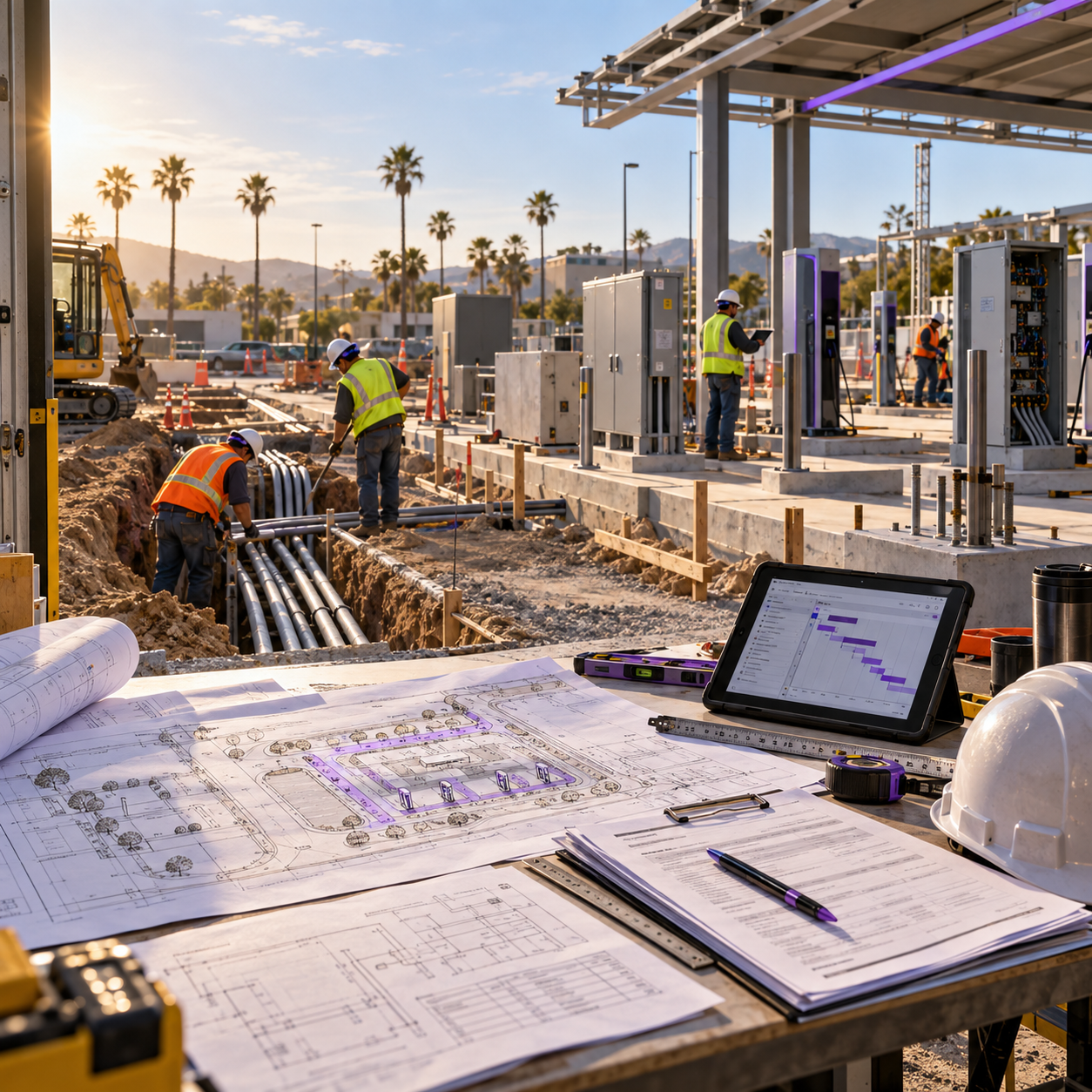
SB 1283 is particularly relevant to infrastructure developers. The legislation clarifies that California’s streamlined permitting rules for EV charging installations also apply to associated work such as trenching, electrical upgrades, solar canopies and battery storage.
That reflects how charging projects are actually being built.
A high-power charging site can require electrical upgrades, civil works, energy management equipment and, increasingly, on-site generation or storage. Treating the charger as a standalone piece of equipment can therefore obscure some of the constraints that determine when a project becomes operational.
SB 969 addresses another stage of that process by modernizing inspection requirements for certain manufacturer-tested public chargers, with the stated objective of allowing equipment to enter service faster while retaining safeguards around electricity measurement.
AB 1820 targets apartments and mixed-use developments, reducing permitting barriers and fees for charging projects in multifamily settings.
Deployment speed is becoming an infrastructure metric
California says it has more than 216,445 public and shared charging plugs, including more than 20,000 DC fast-charging ports. The state also recorded 86,857 new zero-emission vehicle sales in Q2 2026, representing 19.1% of new vehicle sales.
At this scale, infrastructure policy increasingly has to address the process around the equipment, not simply the number of chargers installed.
For charging-network operators and developers, the practical question is whether a project can move predictably through site preparation, permitting, electrical work, inspection and commissioning.
California’s new measures address several points in that chain.
The larger infrastructure question
The legislation does not eliminate the other constraints facing charging deployment. Grid capacity, utility interconnection, equipment availability, construction costs and site economics remain separate considerations.
But it does highlight a shift in how charging infrastructure is being treated.
The next stage of network expansion will require coordination between chargers, electrical infrastructure, buildings, storage, utilities and local permitting authorities.
That makes permitting less of an administrative detail and more of a component of infrastructure delivery.
For developers and charging operators planning large portfolios, the value of a streamlined approval process is therefore not simply fewer forms. It is greater predictability between capital commitment and the point at which an asset can begin serving drivers.