
An ice cream company is about to become a fast-charging operator.
On October 6, United Dairy Farmers, the family-owned ice cream maker and convenience store chain, announced that it will install Electric Era Level 3 DC fast chargers at six stores across Greater Cincinnati and Columbus. They will be the first Level 3 chargers in the company’s history, and the sites were selected through Ohio’s National Electric Vehicle Infrastructure program.
UDF applied for six locations and won all six. The chargers are expected to begin coming online in early 2027.
The announcement is small in port count. It is large in what it says about where public charging is heading: into established retail businesses that already know how to turn a stop into a sale, and onto hardware designed to keep working when the grid connection is tight.
Ohio Is Building the Second Layer of Its Network
Ohio has been one of the most active NEVI states. It opened the country’s first NEVI station in late 2023, and the Federal Highway Administration certified its alternative fuel corridor network as fully built out in the fall of 2025.
That certification gave the state room to look beyond the interstates. In April 2026, the Ohio Department of Transportation said it would award $51 million in federal NEVI funding for 64 new fast-charging sites, with developers adding more than $26 million of their own money, according to Electrek. United Dairy Farmers was named among the selected companies, alongside Aldi, BP, Love’s, Pilot, Sheetz and Tesla.
Each site in that round needs at least four 150 kW ports, plus access to restrooms and food. Construction was expected to start in early 2027, with many stations open by the end of that year.
The UDF stores show what that second layer looks like on the ground. The six sites sit in Hilliard, Lebanon, Mason, Maineville and two Cincinnati neighbourhoods, chosen on charging demand, proximity to major highways, accessibility and the customer experience each store can offer.
These are not remote corridor stops. They are suburban stores that drivers already visit.
Twenty Minutes Is a Retail Opportunity
A gasoline fill takes a few minutes. UDF expects EV drivers to spend 20 to 30 minutes at its stores on average, and it has planned around that number.
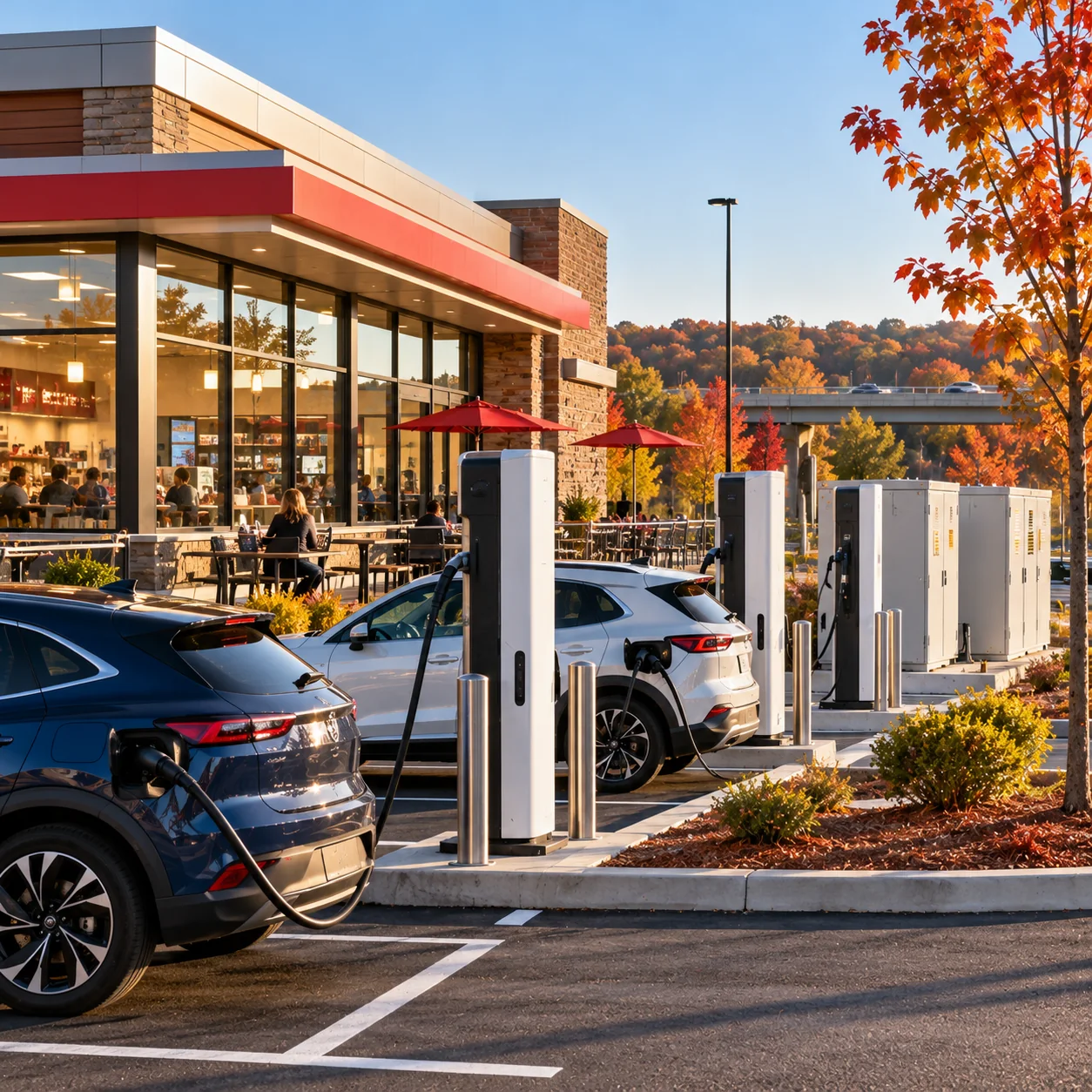
The company deliberately picked some of its newest locations, which have expanded food and beverage options, indoor and outdoor seating, public Wi-Fi and clear sightlines to the charging area. UDF describes the goal as turning its stores into a community “third place” where people can recharge the car and themselves.
“We’re thinking beyond the charger itself and about how we can make those 20 to 30 minute charge times convenient, valuable and enjoyable for our guests,” said Rob Lindner, UDF’s Corporate Head of Initiatives.
That is the commercial logic convenience retail has been circling for years. Charging revenue alone rarely carries a site. Charging that brings a customer inside for half an hour can.
Loyalty Programs Turn Kilowatt Hours Into Customers
The most distinctive part of the UDF plan is how the chargers connect to the store.
The stations will integrate with UDF’s U-Drive Plus loyalty program. Members will receive credits off charging in the same way they already receive cents off gasoline, and they can earn additional charging credits through qualifying purchases inside the store. Personalised offers, including food and beverage promotions, will appear through both the app and the chargers themselves.
That closes a loop that many host sites leave open. When a third-party network runs the charger and the retailer simply leases the parking spaces, the driver’s relationship sits with the network app. Here the retailer owns the experience, the data and the offer.
For other site hosts weighing a similar model, the UDF approach points to a short list of design questions:
- Which stores already have the amenities to hold a customer for 20 to 30 minutes
- Whether chargers can be seen from the seating area
- How charging credits fit inside existing fuel and loyalty economics
- Who owns the driver relationship and the session data
- What grid capacity each site can secure, and how quickly
- Which metrics will decide whether to expand
Battery Storage Makes the Grid Question Smaller
Grid access remains one of the slowest parts of any fast-charging project. Electric Era’s answer is to put storage at the site.
Its chargers combine grid power with on-site batteries and proprietary software to manage power delivery, reducing peak demand and maintaining charging performance even when grid capacity is constrained. For a retailer, that can mean lower demand charges and fewer sites ruled out because the local feeder cannot support a large new load.
Electric Era has been pushing the same idea further. In early October, EV Infrastructure News reported that the company’s software predicted all five 5CP peak events in 2026, and that at one site it cut grid draw to 9 kW during those peaks by drawing on battery storage, according to the company.
That is the kind of capability that makes suburban retail sites viable at scale.
Reliability Is Being Written Into the Deal
The other number in the announcement may matter just as much as the site count.
Electric Era says it guarantees 98% or better per-port uptime and 85% or better first plug-in success. Uptime has become the industry’s standard reliability metric, but first plug-in success measures something closer to what a driver feels: whether the session starts on the first attempt.
For a retailer putting its own brand on the charger, that distinction is critical. A failed session at a network-branded station is a network problem. A failed session in a UDF parking lot is a UDF problem.
Guarantees written at the contract stage push accountability back toward the hardware and software provider, which is where the industry has been asking it to sit.
A Pilot With a Built-In Feedback Loop
UDF operates more than 170 locations across Ohio, Kentucky and Indiana. Six chargers is a measured start, and the company is treating it as one.
It plans to monitor charging demand, customer behaviour, store visits and engagement with amenities and loyalty offers to decide what future expansion looks like. That is the right sequence: prove the economics at a handful of well-chosen sites, then scale on data rather than on assumption.
If the model works, the more interesting outcome is not six chargers in Ohio. It is a template that regional convenience chains across the country can copy, using public funding to cover the first build and their own loyalty systems to make the sites pay.
NEVI paid for the corridors. The next layer of the network may be paid for one scoop of ice cream at a time.