

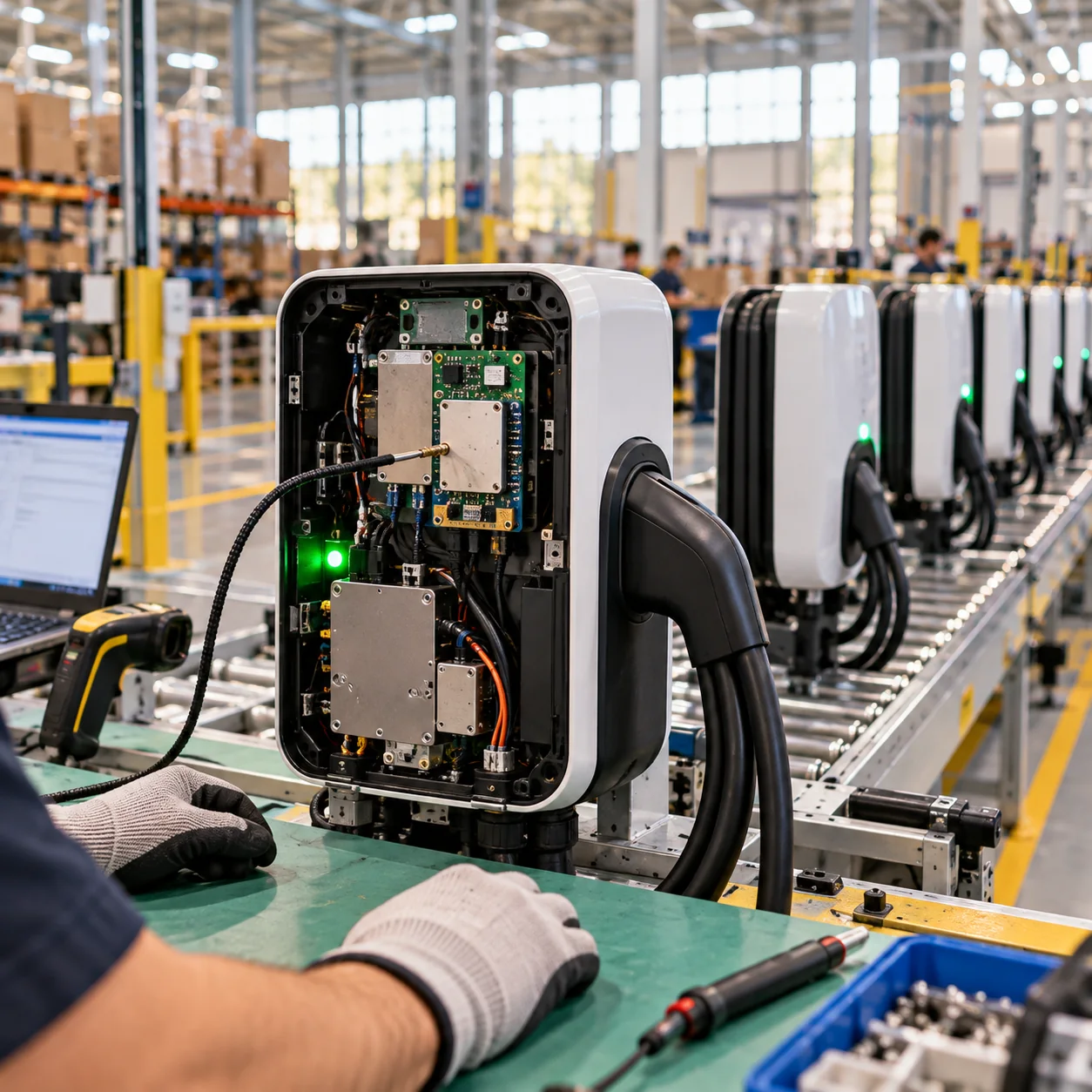
A charger that cannot reach its network does not work as a charger.
On August 25, IoT connectivity provider emnify launched an OEM program that gives device manufacturers free SGP.32 bootstrap connectivity on every unit they produce. A manufacturer can ship one device SKU worldwide with a built-in eSIM profile that connects from the factory onward. That profile handles testing and configuration, then downloads the operational connectivity profile.
The program covers connected hardware in general, and emnify lists EV charging among its markets alongside fleet management, asset tracking and point-of-sale systems. For charging, the timing is good. The industry’s attention has moved from how many ports get installed to how many of them actually work, and a large part of that reliability question starts with a cellular link.
Connectivity Is Part of Uptime
Federal rules make the point plainly. Under the NEVI standards in 23 CFR 680, each funded charging port must deliver average annual uptime greater than 97%. Chargers must conform to the Open Charge Point Protocol, with OCPP 2.0.1 required from February 28, 2024, and real-time port status must be reported using the Open Charge Point Interface 2.2.1.
Every one of those requirements assumes a working connection.
A charger with a dead modem cannot authorize a session through its backend, push status updates to roaming partners or accept a remote reset. To the driver, an offline charger and a broken charger look the same. For the operator, the difference is a remote fix or a truck roll.
That makes connectivity an uptime issue, not an IT detail.
The Problem Starts Before the Charger Leaves the Factory
Hardware makers have usually handled cellular connectivity by fitting physical SIMs during manufacturing, often tied to a particular customer or carrier. That leads to too many SKUs, harder inventory planning and unwelcome surprises on installation day when the chosen carrier has a weak signal at the site.
emnify’s program targets that step. The company describes the offer as one global SKU, with no customer-specific SIMs and no recurring fee. Each eSIM profile includes up to 1 MB of data for factory testing, connectivity validation, configuration changes and operational profile download, with no recurring charge. Participating manufacturers also get design and engineering support from emnify’s technical team, plus test eUICC hardware in all form factors so they can validate integration before production.
“We created the emnify OEM program to make connectivity enablement as frictionless as possible,” said Martin Giess, co-founder at emnify.
Industrial hardware maker Milesight is an early collaborator. Clay Chen, its European sales director, said the approach lets the company “produce connectivity-ready devices directly from the factory.”
Charger Makers Are an Obvious Fit
Charging hardware suits this model well. Manufacturers sell the same dispenser to operators in different countries, and each operator has its own carrier preferences and network software. With a single SKU that can be provisioned remotely after shipment, production gets simpler and the operator, not the factory, decides which connectivity profile goes live.
That flexibility matters in the US, where sites range from underground parking garages with poor signal to rural highway stops served by only one or two carriers. emnify says its network reaches more than 550 mobile networks in over 200 countries. On its EV charging page, the company presents multi-network access as a way to avoid depending on a single operator and to block underperforming networks.
For manufacturers and network operators, the practical questions are becoming clearer:
- Whether chargers ship with remotely provisionable eSIMs or fixed carrier SIMs
- Multi-carrier fallback at sites with weak or single-carrier coverage
- Connectivity diagnostics visible alongside OCPP fault data
- Who holds the connectivity contract: OEM, operator or site host
- How profiles are switched over the charger’s service life
- Field procedures for chargers that drop offline
Fewer Site Visits Mean Better Economics
The cost argument is simple. A SIM swap is a site visit, and so is a failed commissioning attempt caused by poor coverage. Each one adds labour, travel and lost charging revenue to a project whose margins are already thin.
Remote provisioning lets operators change connectivity without touching the hardware. If a carrier underperforms at a location, or a commercial agreement changes, the fix can happen over the air.
Carrier choice moves from the factory to the software layer.
For operators managing thousands of ports, that adds up. It also helps reliability teams separate connectivity faults from hardware faults, so crews arrive with the right parts or do not need to go out at all.
Open Standards Are Reaching the Cellular Layer
emnify says it supports open standards including SGP.02, SGP.22 and SGP.32, and it describes the OEM program as the first in a series of connectivity offerings for device manufacturers, with more options planned.
The charging industry already knows how this goes. OCPP made it possible to change backend software without replacing the charger, which reduced vendor lock-in and gave operators more bargaining power. Standards-based remote SIM provisioning applies the same idea to the cellular connection beneath that software.
Will charger OEMs build connectivity flexibility into their products as standard?
Will operators start asking for it in procurement?
With NEVI-funded stations held to a 97% uptime requirement and private networks competing on reliability, both seem likely. Hardware that arrives connected and stays connected removes one of the least visible causes of downtime.
The charging industry spent years standardizing how chargers talk to software.
The next gain comes from making sure they can always talk at all.