
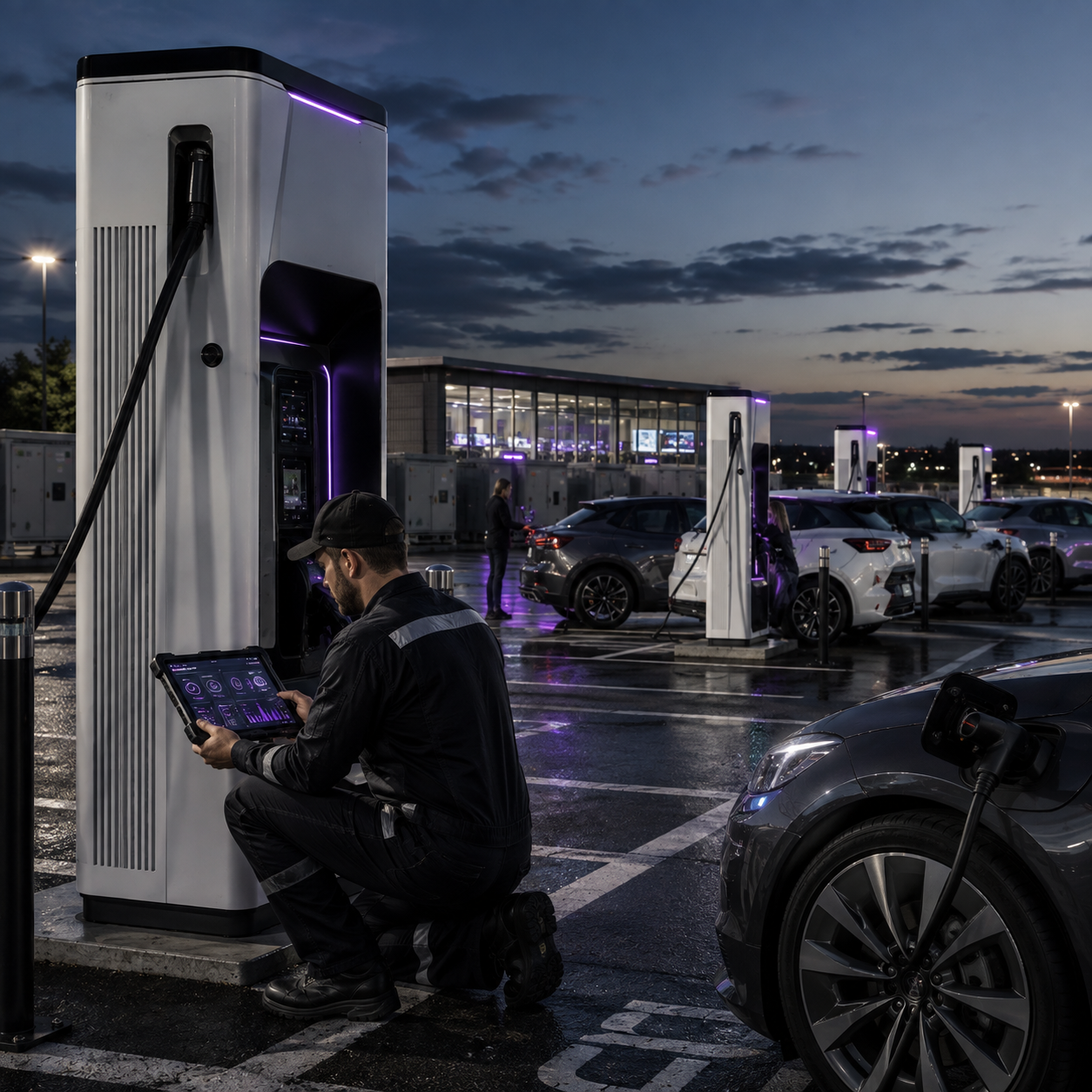
US public EV charging performance is showing measurable improvement, but the latest data also highlights a shift in how charging networks need to be evaluated.
J.D. Power’s 2026 U.S. Electric Vehicle Experience Public Charging Study found that satisfaction with DC fast charging increased by 12 points. The share of charging visits where drivers were unable to charge also declined to 12%, the lowest level recorded in the study.
For charging operators, the implications extend beyond customer satisfaction.
As deployment expands, reliability, maintenance and operational performance are becoming increasingly important components of charging infrastructure economics.
EV Charging Reliability Requires More Than Uptime
A charger can be reported as operational while a customer is unable to complete a charging session.
The outcome depends on several connected systems, including:
● Charging hardware
● Network connectivity
● Authentication
● Payment processing
● Firmware
● Vehicle-charger communication
● Charging-management software
A failure within any of these components can interrupt a session without necessarily appearing as conventional equipment downtime.
For network operators, this makes successful charging sessions an important complement to conventional uptime measurements.
Network Performance Affects Asset Economics
Reliability has a direct relationship with infrastructure utilization.
Repeated failures can reduce energy throughput, increase service costs and affect customer retention. For high-volume charging locations, these factors can influence the financial performance of the site.
Operational data can therefore support more than maintenance decisions. It can help operators identify:
● Recurring equipment failures
● Locations with abnormal downtime
● Mean time to repair
● Connector-level performance
● Failed authentication or payment events
● Vehicle-specific compatibility issues
● Patterns preceding service interruptions
This provides a more detailed view of how charging assets perform after deployment.
Maintenance Is Becoming More Data-Driven
As networks expand, relying exclusively on reactive maintenance becomes increasingly difficult.
Operators need to identify which failures require physical intervention and which can be resolved remotely through software, configuration changes or system resets.
Predictive maintenance can also help prioritize field-service activity according to the probability and commercial impact of failure.
The objective is straightforward: reduce unnecessary service activity while shortening the duration of genuine outages.
For large networks, even modest improvements in mean time to repair can affect operating costs and charger availability.
The Importance of Measuring Successful Sessions
The latest J.D. Power findings indicate that public DC fast-charging reliability is improving.
The next step is to understand what that improvement means at the individual network and site level.
Operators should increasingly distinguish between:
Installed capacity — how many charging ports exist.
Available capacity — how many are operational.
Usable capacity — how many can successfully serve a vehicle.
Productive capacity — how much energy those assets actually deliver.
These measures provide a more complete assessment of infrastructure performance than deployment figures alone.
What This Means for Charging Infrastructure Operators
The economics of EV charging increasingly depend on what happens after infrastructure has been installed.
Reliable equipment, effective maintenance, accurate performance data and rapid fault resolution all contribute to the productivity of charging assets.
For operators and investors, the relevant question is therefore moving from:
How many chargers are deployed?
to:
How consistently can those chargers deliver energy to customers?
That distinction will become increasingly relevant as US charging networks mature and infrastructure owners place greater emphasis on utilization, operating costs and long-term asset performance.